
Following the market analysis and business overview, the next step was to assess the business through an Environmental, Social, and Governance (ESG) lens.
Why is this important? ESG provides a structured framework for understanding the factors that can influence a company’s long-term performance, resilience, and ability to create value. Rather than viewing sustainability as a collection of isolated initiatives, the ESG approach helps organise topics into clear and actionable categories, making it easier to identify risks, opportunities, and areas for improvement.
For a restaurant business, ESG considerations extend far beyond environmental impacts. They include topics such as food waste, procurement practices, employee wellbeing, customer expectations, supplier relationships, business ethics, and regulatory compliance. Many of these factors already influence business performance, whether they are formally recognised as sustainability issues or not.
However, not all ESG topics are equally relevant to every organisation. The challenge is understanding which issues matter most to the business and its stakeholders, and where efforts should be prioritised. This is where a materiality assessment becomes valuable.
MATERIALITY ASSESSMENT ROADMAP
A materiality assessment is a process used to identify, assess, and prioritise the topics that are most relevant to a business and its stakeholders. It helps organisations focus their resources on the areas that have the greatest impact on performance, risk management, and stakeholder relationships.
For this project, the materiality assessment served as a bridge between understanding the business and developing a sustainability strategy that was practical, relevant, and aligned with business objectives.
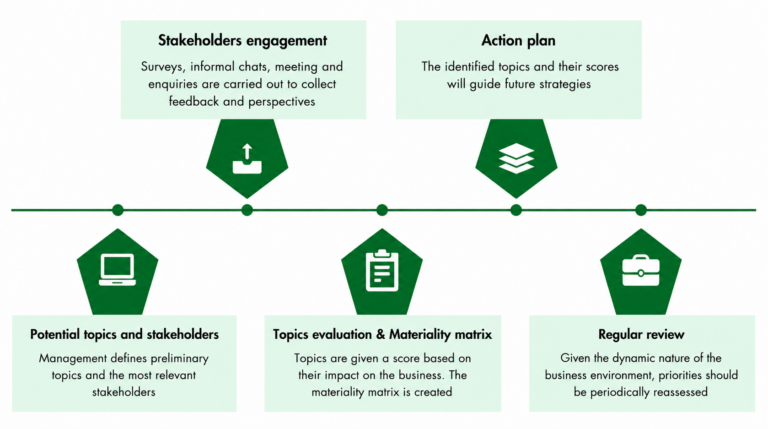
- Identifying potential material topics and stakeholders
The process began with discussions with management to understand their current perspective on sustainability and business challenges.
Rather than starting with predefined solutions, the objective was to explore how management perceived different aspects of the business, what concerns they had, what opportunities they saw, and what changes they would like to achieve in the future. We discussed operational challenges, growth ambitions, supply chain relationships, customer expectations, and long-term goals.
This initial exercise provided valuable insights into how sustainability-related topics were already influencing business decisions, often without being explicitly recognised as such. Using insights from the market analysis, business overview, and management discussions, a preliminary list of potential material topics and stakeholders was developed.
These topics were grouped under broader ESG categories and represented areas that could influence the business’s performance, reputation, and future competitiveness.
Some of the topics identified included:
- Food waste and inventory management
- Employee well-being and retention
- Training and development
- Energy and resource efficiency
- Regulatory compliance
Stakeholders
- Customers
- Employees
- Suppliers
- Regulators
2. Stakeholder engagement
The next step was to gather input from key stakeholders.
To achieve this, anonymous employee surveys were conducted to understand perceptions around workplace culture, fairness, inclusion, communication, and overall employee experience.
Informal conversations with customers were encouraged to better understand their expectations, perceptions of sustainability, openness to change, and factors influencing their purchasing decisions.
Discussions with suppliers were also initiated to gain insight into their challenges, future plans, sustainability initiatives, and opportunities for collaboration.
The purpose of stakeholder engagement was not only to gather feedback, but also to understand different perspectives across the value chain and identify areas where interests aligned.
3. Evaluating and prioritising topics + materiality matrix creation
Once stakeholder feedback had been collected, the information was analysed and consolidated.
From the various feedback, recurring stakeholder concerns emerged and were translated into material ESG topics. Each topic was evaluated against key criteria (impact severity, stakeholder concern, financial risk, strategic relevance, impact materiality, and financial materiality) and scored on a scale of 1 to 5.
The resulting scores were then mapped onto the materiality matrix. This structured approach helped transform qualitative feedback into actionable priorities, providing a clear basis for risk management and the definition of future sustainability goals.
4. From material topics to action
The material topics identified through the assessment became the foundation for the next stages of the project.
They informed the risk assessment process by highlighting areas where the business could be exposed to operational, regulatory, financial, reputational, or supply chain risks.
They also provided a basis for defining future objectives, initiatives, and performance indicators, ensuring that efforts would be focused on areas capable of generating meaningful business value.
Importantly, a materiality assessment should not be viewed as a one-time exercise. Markets evolve, regulations change, stakeholder expectations shift, and new risks emerge. For this reason, material topics should be reviewed periodically to ensure they continue to reflect the business environment and strategic priorities.