
Materiality Assessment
- Identifying potential material topics and stakeholders
After gaining an understanding of the business and its operating environment, the first step was to identify the key challenges, concerns, and priorities from management’s perspective. Rather than starting with predefined sustainability topics, the discussion focused on questions such as: What are the main challenges facing the business today? What would you like to improve? What risks do you see for future growth and success?
Several recurring themes emerged, including rising food and operating costs, staff turnover and training needs, food waste, inventory inefficiencies, procurement challenges, supply chain uncertainty, changing customer preferences, and the ability to respond quickly to evolving market expectations. These business concerns formed the basis for identifying potential material topics.
The next step was stakeholder identification and mapping. Stakeholders were assessed based on two criteria: their level of influence on the business and their level of interest in its activities and future direction. Each stakeholder group was assigned a score from 1 to 5 for both dimensions, allowing priorities for engagement to be established.
An engagement approach was then defined for each stakeholder group. Customers were engaged through informal conversations and feedback opportunities designed to encourage honest and spontaneous input. Employees participated through surveys and discussions focused on workplace experience and operational challenges. Suppliers and senior management were engaged through more structured conversations aimed at understanding their priorities, concerns, future plans, and opportunities for collaboration.
| Stakeholder Group | Category | Department / Entity | Influence Score (1–5) | Interest Score (1–5) | Engagement Strategy | Preferred Engagement Method | Engagement Frequency |
|---|---|---|---|---|---|---|---|
| Board of Directors/Investors | Internal | Board Office | 5 | 5 | Manage closely | Board meetings | Quarterly |
| Senior Management | Internal | HR | 3 | 4 | Collaborate with | 1:1 meetings, strategy meetings | Quarterly |
| Employees | Internal | HR | 3 | 4 | Keep Informed | Surveys, 1:1 meetings, suggestion box | Annually |
| Suppliers | Supply Chain | Procurement | 3 | 3 | Keep Informed | Sustainability assessments, direct conversations, surveys | Annually |
| Customers | External | – | 4 | 5 | Keep Satisfied | Post-visit survey, social media feedback, reviews | After Every Visit |
| Regulators | Regulatory | Compliance / Legal | 4 | 4 | Keep Satisfied | Compliance meetings, townhall meetings, formal written inquiries | As Required |
2. Stakeholder engagement
In this phase, questionnaires were developed to gather employees’ perspectives on key workplace and operational topics. At the same time, staff were encouraged to engage in informal conversations with customers to better understand their expectations, perceptions, and overall dining experience, in line with the previously defined engagement approach. The questionnaires used are attached below.
As this was the first time the business had undertaken a stakeholder engagement exercise of this kind, management was conscious of potential scepticism and low participation rates. For this reason, particular attention was given to tailoring the engagement approach to each audience, ensuring interactions felt natural, approachable, and voluntary rather than formal or intrusive. The objective was to encourage honest feedback and build trust, without creating resistance or a sense of extra work.
| Stakeholder Category | Engagement Method | Responsible | Tentative Timeline (Weeks) | Inputs |
|---|---|---|---|---|
| Board of Directors/Investors | 1:1 meetings | All | 4–5 | Employee survey results (first time to be conducted) |
| Senior Management | 1:1 meetings, strategy meetings | Directors | 4–5 | Quarterly performance reviews |
| Employees | Suggestion box, surveys | HR | 4–5 | Communicate new goals formally and emphasise the importance of employee engagement while ensuring anonymity |
| Suppliers | 1:1 interactions | Directors | 4–5 | Approach with informal conversations and assess interest and willingness to collaborate. If positive, move to more structured surveys |
| Customers | Surveys, reviews | Marketing Team | 5 | Compile reviews and feedback from the past 3 years |
| Regulators | Formal written enquiry | HR | 5 | Enquire about upcoming regulations |
3. Evaluating and prioritising topics + materiality metrix creation
We collected feedback over a four-month period, which was considered sufficient to complete an initial review and to begin developing the sustainability plan, with the aim of starting implementation by July 2026. After the feedback collection phase, the results were compiled and analysed.
This allowed us to identify the most frequently recurring themes and translate them into material topics within an ESG framework. Each topic was then assessed and scored on a scale from 1 to 5 based on defined criteria, enabling a structured comparison of their relevance and impact on the business.
- Impact Severity: How much a topic can impact people and the environment.
- Stakeholder Concern: How important the topic is to stakeholders and how frequently it is raised during engagement activities.
- Financial Risk: The extent to which the topic could create financial costs, losses, or revenue impacts.
- Strategic Relevance: How closely the topic relates to the company’s long-term objectives.
- Impact Materiality: The impact of the company’s activities on people and the environment.
- Financial Materiality: How a sustainability topic could affect the company’s financial performance.
The final score allowed us to assign a clear level of priority to each topic. This was an important step, as it highlighted the areas the company should focus on as a priority in order to mitigate risks, comply with regulations, ensure employee and customer satisfaction, and address the initially raised concerns.
Formalising this process in writing was essential, as it enabled us to move from broad and abstract concerns to a more structured and actionable framework. It also ensured that the perspectives of all relevant stakeholders were taken into account, translating qualitative feedback into concrete priorities to guide future decision-making.
| ESG | ESG Topic | Impact Severity | Stakeholder Concern | Financial Risk | Strategic Relevance | Impact Materiality | Financial Materiality | Total Weighted Score | Risk |
|---|---|---|---|---|---|---|---|---|---|
| Environment | Food Waste Reduction | 4 | 3 | 3 | 4 | 4 | 3.5 | 4 | High |
| Waste Management & Recycling | 4 | 4 | 4 | 4 | 4 | 4 | 4 | Medium | |
| Sustainable Sourcing | 4 | 5 | 3 | 5 | 4.5 | 4 | 4.25 | Medium | |
| Energy Efficiency | 3.5 | 3 | 4 | 4 | 3 | 4 | 3.75 | Medium | |
| Greenhouse Gas Emissions | 3 | 4 | 3 | 4 | 3.5 | 3.5 | 3.5 | Medium | |
| Water Management | 3.5 | 3 | 3 | 3.5 | 3 | 3.5 | 3.5 | Medium | |
| Social | Food Safety & Hygiene | 5 | 5 | 5 | 5 | 5 | 5 | 5 | High |
| Employee Health & Safety | 4 | 4 | 4 | 4 | 4 | 4 | 4 | High | |
| Fair Wages & Labour Conditions | 5 | 4 | 5 | 5 | 4.5 | 5 | 4.75 | High | |
| Training & Development | 3 | 3 | 3 | 4 | 3 | 3.5 | 3.5 | Medium | |
| Diversity & Inclusion | 3 | 3 | 3 | 3 | 3 | 3 | 3 | Medium/Low | |
| Governance | Regulatory Compliance & Ethics | 5 | 5 | 5 | 5 | 5 | 5 | 5 | High |
| Responsible Marketing & Promotion | 3 | 3 | 4 | 3 | 2 | 3 | 3 | Medium |
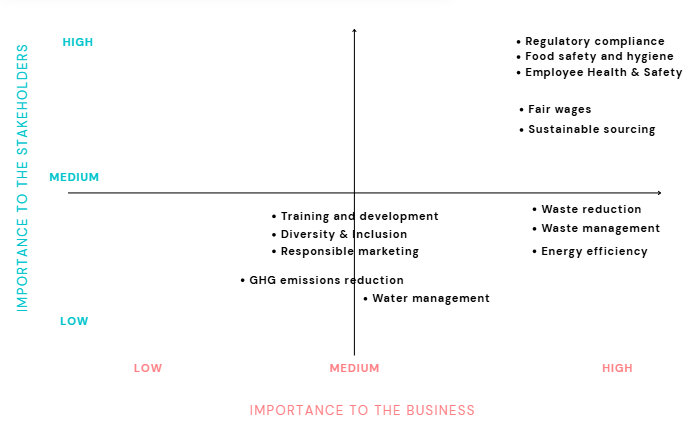
Materiality Matrix
Finally, the results were mapped onto a materiality matrix, which is a visual representation of the topics and their scoring based on importance to the business and its stakeholders.
Conclusion
Higher-priority topics the company will focus on.
The following topics have been identified as the highest-priority ESG issues based on their overall materiality, stakeholder importance, and potential impact on the business.
- Food safety & hygiene
- Employee health & safety
- Sustainable sourcing
- Regulatory compliance & ethics
Strategic Business Priorities with Financial Benefits
The following topics are considered strategically important because they can enhance operational efficiency, reduce costs, and create long-term financial value for the business.
- Food waste reduction
- Waste management & recycling
- Energy efficiency